Wednesday, January 16, 2013

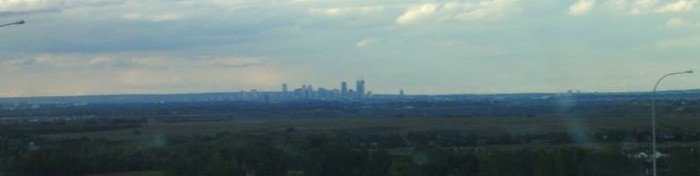
Visit Inglewood, in Calgary

InglewoodInglewood is one of my favorite neighborhoods in Calgary. It has everything! It has ambiance (in places), it has characters (in places)... it's got high-end and low-end... Harley Davidson shops and candle shops...art shops, clothing boutiques, cupcake stores, health food store for pets, bead shops... and restaurants galore!
 
This is the first place I lived when I moved to Calgary. I loved it so much, we rented a basement suite for years, because we couldn't afford to buy a house there, and didn't want to leave.
 
AND, it was kind of a bad neighborhood back then - with the potential to be trendy, if a little bit of clean up was done. And done it was!
 
Now it's a neighborhood for strolling, and window shopping, and spending all day visiting friends in a wine bar, and then going to look at retro fashion, or replenishing your herbs and spices collection.
 
Apparently, Inglewood was established in 1875, the very year the NorthWest Mounted Police (now the RCMP) were assigned to the area. In 1876, the post was renamed Fort Calgary, and became "the City of Calgary" in 1894.
Fort Calgary
Deane HouseThe original "Fort Calgary" is now a historical site, open for tours, with an admission fee (currently $12 for adults and various fees for children and students.) http://www.fortcalgary.com/ (Is it obvious that Fort Calgary is attached to Inglewood? I guess I better clarify.)
Fort Calgary
Just on the other side of the bridge from Fort Calgary, and on the Inglewood side, is The Deane House, built in 1906. Captain Richard Deane, the superintendent of Fort Calgary, built it for his wife, Martha. (Unfortunately, she died before she arrived in Calgary.)
 
In 1978, the Deane House was made a historic resource, and is operated by the Fort Calgary Preservation Society.
 (http://www.fortcalgary.com/visiting/deane/). The Deane House hosts a Murder Mystery dinner, and has a menu for lunch and dinner, too. The layout of the house is probably like it was originally built (although I'm just guessing) - when we were last there (for a Mystery Dinner), we were escorted through a few smaller rooms, till we got to our own cozy room, which could easily have been one of the original dining rooms. It's a beautiful house.
 
Blackfoot Truck StopOn the opposite end of 9th Avenue (which is the main road through Inglewood), is the Blackfoot Truck Stop - the opposite end of and the opposite ambiance. The Truck Stop is a typical diner from sometime in the past (I want to say the 50's...maybe the 70's...) Do you remember that show, Alice? with Flo, in Mel's Diner? (1976-1985, http://www.imdb.com/title/tt0073955/).
That's this place. They even wear pink uniforms.
 
The best diner food EVER! burgers with any topping, French fries, meringue pies, milk shakes, corn beef hash, bacon and eggs with pancakes... and I don't think they have a "breakfast until 10am" rule. You can order whatever you want to order, whenever you want to order it.
 
Hose and HoundBetween the Deane House and the Blackfoot Truck Stop are so many restaurants! I was going through the list (http://www.calgary-inglewood.com/Home-New) and on almost all of them, I could say, "Oh we've eaten there - it was really good!" The best thing to do is either 1) review the list online and pick, or just wander down 9th, and pick randomly. (I can't even narrow it down, but often, I end up at the Hose & Hound (the old Fire Station, serving pub food), Salt & Pepper (Mexican food), and Without Papers (pizza). I don't mean to exclude, though - there's so many that I love!)
 
Even though we don't live there anymore, I'm in the neighborhood all the time.
 
In fact, tomorrow, I have to go pick up Daisy & Coco's dogfood (they are on a raw food diet... I tried to make it myself, originally, and I've got to tell you - it was SO GROSS!! I'm still traumatized! SO DISGUSTING!! I'd MUCH rather buy it.
 
Tail Blazers
 
Besides - it's professionally made, so they (hopefully) have it all mastered as to the proportions of vegetables and fruit to meat..) I buy the food at this cute little health food store for pets - called Tail Blazers. (http://www.tailblazerspets.com/) There are (at least) three in Calgary, and I'm sure that the owners are just as wonderful at each place, but I love the person who owns the one in Inglewood, Milena. Not only does she know everything (at least everything I ask), but she's so nice and friendly, and never rushed.
 
My other favorite place is the Silk Road Spice Merchant. (http://www.silkroadspices.ca/) As they explain in their website, "we grind our own spices to ensure they are never sitting for months in a warehouse. All of our spice blends are hand-mixed and have been developed, tested, and perfected by us.
 
Silk Road Spices We mix them using fresh ingredients, and we don’t bulk them up with cheap fillers like salt. You will be amazed at the difference in freshness and flavour compared to most commercial spice blends." And, it's true! I kept my old oregano just so I can do "scent" tests ~ comparing my old chain-grocery store brand with my Silk Road brand - you canNOT believe the difference!! (And, the price is about the same - but since you don't have to use as much, the value outweighs the price.)
 
Fuschia velveteenAround the time I discovered the Silk Road Spice Market, my mother-in-law told us (thriftily and happily) that she still had some herbs and spices that she used from BEFORE Peter was born!! (I'm can't tell you how old he is, but I can tell you that is TOO OLD for herbs and spices!!) I went through her collection and replaced them all. (We had to warn her that 1) she was not allowed to use up her old stuff before she started her new herbs & spices - she had to throw out the old; and 2) she had to be cautious about how she used them - in that she didn't need to use the same amounts to get flavor).
 
I spent HOURS in a little store called "Pretty Little Things", and could've spent more time there, but after I bought my knee-length fuchsia velveteen coat with its polka dot sleeves, I realized I had to leave. If you have will-power though, you MUST go in.  (https://www.facebook.com/PrettyLittleThingsConsignment)
Old and new
And, finally, my favorite go-to place is Zyn, the Wine Market. They know everything and they can find everything, and if they don't have it already, they can make a better recommendation! Also, they aren't snobby - but they do know their wines, and they are informative and friendly. (http://www.zyn.ca/)
 
I could go on and on and on - I've skipped so many good places... I'm sorry to those I skipped. http://www.calgary-inglewood.com/Home-New
 
On another topic - the Ice Magic Festival (http://www.banfflakelouise.com/Area-Events/Festivals/Winter/SnowDays/Ice-Magic-Festival) starts this Friday (January 18)! We're hoping to go - you may seem some blog about it in the future. In the meantime, Sunday, I think we're going to Michigan!

Sunday, January 13, 2013

Great Falls, and then! Home Again, Home Again, Jiggedy Jog!

SceneryCan you believe it? this is the last post in this particular segment – the end of the original “Biggest Ball of String Tour.” Not that I’m done writing. Next, we are moving on to one of our trips to Michigan.
 
Technically, we could’ve driven home from Butte, but 1) my cousin and her husband had come to visit us there, so we wanted to leave Butte leisurely, and not on a specific schedule, and 2) we didn’t want our road trip to be over! So, we meandered to Great Falls, which is only 2 1/2 hours from Butte! (By the way, this is the point where we sadly had to say "see you soon" to Brian and Taunya and crew, as they headed back towards Seattle.)
 
Besides, we’d never really spent any time in Great Falls, but aLOT of Canadians go to Great Falls to shop, especially for school supplies, etc., making a weekend getaway of it. (Great Falls is less than 2 hours from the US/Canada border, and about 5 1/2 hours from Calgary.)
 
Sacajawea, baby, and Lewis and ClarkOnce upon a time, the first people who lived in the Great Falls area were, of course, Native Americans. The Lewis and Clark Expedition went through 1805/1806, but the area wasn’t “founded” until 1883, when a businessman, named Paris Gibson, was in the area and recognized the potential for building an industrial city near “the great falls” – which would provide power by hydroelectricity. (When Meriwether Lewis (of the Lewis and Clark Expedition) first saw it in 1805, he said the Great Falls were the grandest thing he’d ever seen!)
 
By 1887, 1200 people lived there. By October, 1887, the Great Northern Railway arrived. (The Steamboat had arrived in 1859, by way of the Missouri River, which runs through. Apparently, THE Great Falls was as far as the Steamboats could go, anyway, because it was impossible to “portage” them… “Portage”, in case it’s not a familiar term to you, means ”The carrying of a boat or its cargo between two navigable waters” as per… all on-line dictionaries.) And, by 1888, Great Falls was incorporated.
 
As hinted, Great Falls was named for THE Great Falls of the Missouri River. These are a series of 5 waterfalls, which include Black Eagle Falls, Colter Falls, Rainbow Falls, Crooked Falls (a.k.a. Horseshoe Falls), and The Great Falls. The Great Falls is the highest, at 87 feet (26.5 meters), although, apparently, most of its water is diverted to Ryan Dam, for hydroelectric power. (The Ryan Dam is 1336 feet (407 meters) long and 61 feet (19 meters) high. Because of all of the hydroelectric dams (5), the city of Great Falls has been called “Electric City.”)
Crossing the MissouriSame bridge
Speaking of… you might be recall, we talked about Lewis and Clark in my blog of January 6, 2013, about Lewis and Clark Caverns. Interestingly, Meriwether Lewis and William Clark never actually went to the Caverns, but they DID go to Great Falls. (The Lewis & Clark Expedition was commissioned by Thomas Jefferson – see blog December 11, 2012 (Mount Rushmore) for some summarized details about Jefferson!)
Lewis and ClarkThe Expedition (Also known as the Corps of Discovery Expedition) stretched from St. Louis, Missouri (blog Nov. 20, 2012 about St. Louis) to Fort Clatsop, where the Columbia Basin empties into the Pacific Ocean…. there ~ and back again!
 
National Geographic did a series on the Lewis and Clark Expedition (http://www.nationalgeographic.com/lewisandclark/journey_intro.html), and their on-line introduction explains: “In 1803 Thomas Jefferson sent Meriwether Lewis and William Clark’s Corps of Discovery to find a water route to the Pacific and explore the uncharted West. He believed woolly mammoths, erupting volcanoes, and a mountain of pure salt awaited them.
 
What they found was no less mind-boggling: some 300 species unknown to science, nearly 50 Indian tribes, and the Rockies. “ (The ”Journey Log” is REALLY interesting!!
 
On occasion, especially as we travel through and to various Montana destinations, we pass or follow the Lewis & Clark Trail.
 
Great Falls is the home of one of the Lewis & Clark Interpretive Center, and gets 5* reviews on Tripadvisor. One review says: “I was absolutely blown away. I’ve been to other Lewis & Clark sites and this is nothing like any of them. You walk through the exhibits that take you through the entire journey and attempt to give you a feeling of what they were experiencing.”
(http://lewisandclarktrail.com/section3/montanacities/greatfalls/lcinterpretive/index.htm) (http://www.tripadvisor.ca/Attraction_Review-g45198-d103830-Reviews-Lewis_Clark_National_Historic_Trail_Interpretive_Center-Great_Falls_Montana.html)
Lewis and Clark on the Lower Columbia by Charles Russell (1905)
 
Great Falls also is famous for being the home of Charles M. Russell – famous Old West artist. Born in St. Louis in 1864, he moved to Montana when he was 16, to work on a ranch. He finally settled in Great Falls, after he was married, in 1896, and stayed there, until he died in 1926. (According to Wikipedia,” On the day of Russell’s funeral in 1926, all the children in Great Falls were released from school to watch the funeral procession. Russell’s coffin was displayed in a glass sided coach, pulled by four black horses.” http://en.wikipedia.org/wiki/Charles_Marion_Russell)
Visit the CM Russell Museum at http://cmrussell.org/about/about-the-museum for more information.
 
Margarita Besides CM Russell, others who have called Great Falls “home” include (apparently) Charley Pride (best known as a country western singer), Walter Breuning (was once the oldest known man in the world – 1896-2011), a lot of professional athletes, AND the shortest river in the world – the Roe River, which is 201 feet long….(not sure if that record has been “beaten” or not – apparently Guiness Book of World Records stopped have “shortest river” as a category in 2006.)
 
Also, many movies have been filmed here, including The Untouchables (1987) and A River Runs Through it (1992).
 
Despite the many interesting things to do in Great Falls, and its fascinating history – we were really just concerned that it was our last chance to eat yummy (hopefully) delicious Mexican food before we crossed the border!
 
AND we did!
 
We had delicious enchiladas and chili relleno at El Comedor, and let’s not forget to mention the mmmmmmmargaritas!!!
enchilada Chili Relleno
We had a nice, peaceful drive home the next day – it was a beautiful surprise to see the flax blooming beside the canola, with seas of blue and yellow. And that’s it! Home sweet home!!
CanolaCanola and flax
Never done – I will be talking about something-Calgary on Wednesday, and then on to Michigan!
Calgary
http://www.greatfallsmt.net/

Wednesday, January 9, 2013

Butte, Montana

Lucille_Ball_by_Koyuki_ShiraiLucille Ball (who was from Jamestown, New York) chose to tell people she was from Butte, Montana.. of all the places she could choose. Apparently, this was to "seem more middle America." Of course she would do something so random, and choose a such a random place!
Why? why? why would she choose Butte? Well, let's just see what kind of fascinating place Butte was/is...
FIRST of all, it's pronounced "Beee-oot", not "Butt". Most people know this and are just being sassy, but.. just in case some don't...
(A "butte", for those who actually don't know, means "A hill that rises abruptly from the surrounding area and has sloping sides and a flat top." Considering the landscape, it's a perfect name! Of course, when I look for a picture to support that, I can't find a single one...maybe it's because there's buttes the whole way there, and then mountains and rocks, once you arrive...)
A butteTHIS particular Butte was once a famous (infamous?) mining town. It's best know for its copper mining, but did you know that they first discovered gold there? That's what actually brought prospectors to the area, in 1864, the year after the gold strike in Virginia City (see blog January 2, 2013).
 
However, the miners ran into so much silver while searching for gold, extracting the gold was very difficult!
 
In 1868, the miners' focus officially switched to silver. The silver market peaked in 1887, but crashed in 1893, thanks to the "Silver Panic of 1893", which was a severe economic depression, that has something to do with railroads and gold and silver and banks and inflation. (I think I got the gist of it, but if you want to know more, you will have to do your own research.)
 
In the meantime - the miners had found copper while they had been searching for gold in the 1870's... after a delay, trying to adjust in the turn in the economy, the focus was turned to copper mining. It was really right on time.
Butte scenery
Up until the late 1880's, copper had only been used for pots and pans, roofing material and other odds and ends. However, with the popularity of electricity, came the need for copper for electricity's wires. Everyone wanted it! Street lights, electricity in the homes...
 
In 1882, a man named Marcus Daly discovered a deposit that contained up to 35% copper. (This earned the hill - Butte Hill - the title of "The Richest Hill on Earth.") By 1898, Butte was the biggest supplier of copper, supplying 41% of the copper for the entire world!!
 
A smelter was built nearby (30 miles) in a newly constructed city, called Anaconda. (Smelting is a process of heating ore in order to extract precious metals.)
 
The World Wars further increased the need for copper (apparently, it was included in all of the bullets), and Butte was considered one of the most prosperous cities in the United States. By the late 1920's, the Anaconda Mining Company was apparently the fourth largest company in the world!!
Berkeley Pit


In the 1950's, to reduce costs of underground mining, the Anaconda Mining Company started open strip mining - which basically meant that they just removed the ground above, rather than tunnelling through it, which is what you can see evidence of today, and for which Butte is most well-known, nowadays.
You can visit the Berkeley Pit ($2 to visit the viewing platform.)


 The www.visitmt.com website confirms that the pit is 7000 feet (2134 meters) long, 5600 feet (1707 meters) wide, and 1600 feet (488 meters) deep.


Washington MonumentThe smelter itself was demolished in 1981, but the Anaconda Smelter Stack is still standing. (I've searched through all of my pictures - somehow, I don't have one. That's the problem with the days of "film" (which shows how long ago I went through Anaconda) - pictures are hidden in a massive jumble of other pictures, and I can't find even one.)
 
The smelter stack is 585 feet tall. To put that into perspective, Wikipedia explains that the Washington Monument could actually fit inside of it!!
(http://en.wikipedia.org/wiki/Anaconda_Smelter_Stack)
 
The Pit was closed in 1982. The pumps were turned off and started to fill with water. (Somewhere I read that it's about 1000 feet full, so far...but I forget the date that that report was written...) The water, mixed with all of the minerals, is toxic (sigh) so that's a new thing that has to be fixed, and there's a plan... there's a strategy in place... they are working on it.
 
It's interesting - I think we visited there (the first time) probably shortly after the mine had shut down. At that time (from my memory), they hadn't really done a lot of restoration on the town, and many surrounding houses were buried in the dirt that had been taken from the mine area. I remember it being a very sad and dirty place.
 
Perhaps they were in their mourning period (or I'm remembering wrong), because this past trip, it was a nice little city (2010 census confirms the population around 34,000), clean, with a lively downtown area. (Although a different kind of "lively" than from once upon a time - when it included an entire "red-light district".... you can tour the brothel (this brothel was still active until 1982!!!) ...we haven't taken the tour, but it's an option! Wikipedia says that "In its heyday...it was one of the largest and most notorious copper boomtowns...home to hundreds of saloons and a famous red-light district." "Notorious" seems like an appropriate word.)
 

Montana sceneryYou can take a trolley tour around the city (http://www.buttecvb.com/listing/butte-trolley/) and it'll take you around to the historical sites, including the Berkeley Pit viewing area (which, according to this website) is the only stop. But, they will pass the Copper King Mansion, the Dumas Brothel Museum, and some other places that seem very interesting, that I didn't write about, like the Mai Wah Museum and the National Landmark Historic District.
 
Another tour which seems REALLY Interesting is a tour of Butte's Underground City. (I didn't know it existed until my brother told me, and we'd already passed through - it's on my "to-do" list for next time.)
http://www.buttetours.info/tour.htm (Tripadvisor reviews are all 5*.)
 
(Apparently, Butte's Underground City tour is similar to the Moose Jaw Underground Tours, which we also missed, but talk about in my September 29, 2012 blog.)
 
Part of the Underground tour apparently includes a below-ground city jail, where Evel Knieval spent some time...which segues nicely into my segment on him!
 
Butte scenerySpeaking of "notorious", "famous" and "infamous", the famous dare-devil, Evel Knieval was born in Butte, in October 1938. There is a an annual celebration each summer ~ the Evel Knievel Days. On the second day, there is a moment of silence for the entire Knievel clan, ending with 5 daredevils jumping over 19 trucks, all at the same time! AND with 50 foot flames shooting up through the trucks! YIKES!
 
Evel Knievel started racing around Butte on his bicycle at a very young age, laying a foundation for his future career as a motorcycle riding daredevil.
 
After he was an adult, and had to be more responsible, he got a job at the Anaconda Mining Company, but was eventually fired because he "made the earth mover do a motorcycle-type wheelie and drove it into Butte's main power line."
 
After tries at desk jobs (something about insurance), and some smaller motorcycle shows (his first public show involved jumping over a 20 foot box of rattlesnakes and 2 mountain lions. Though mildly successful, it wasn't enough to support his family.)
 
His first big show was January 1966, in California, and was a huge success! His career was launched!
 
He is super famous for setting all kinds of records in his life time - He also set a World Record for jumping 19 cars, in February 1971. In February 1973, he set the Record for jumping 50 stacked cars!! His motorcycle is now in the Smithsonian’s National Museum of American History. AND he is in the Guiness Book of World Records for surviving having the most bones broken in a lifetime (including several concussions)!
 
Many little boys had Evel Knievel toys, action figures and accessories. Even Peter remembers having an Evel Knievel motorcycle toy. He was an icon, representing a very specific time period. If you don't remember him in his red, white and blue jumpsuit, with stars and stripes - you have to Google for some images!!! A 1970's icon.
 
Pasty shopIn November 2007, he died of pulmonary disease, and is buried in the Mountain View Cemetery, in Butte.
 
He was inducted into the AMA Motorcycle Hall of Fame in 1999, and the Sturgis Hall of Fame in 2011. (For more on Sturgis, please see my December 18, 2012 blog.)
 
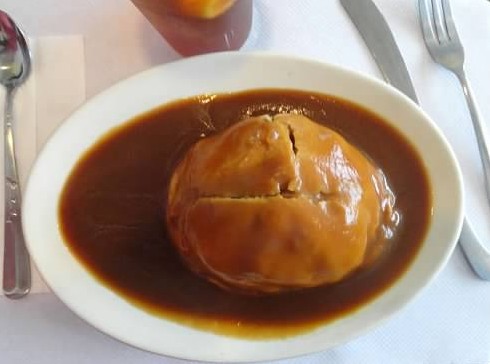
When in Butte, try the foods for which they are famous! Three restaurants were featured on Man Vs. Food, on the Food Network. One such place was Joe's Pasty Shop. (This is "PASS-TEE", not "PAY-STEE", because, as they explain "Pay-stees are for strippers.") Pasties are basically meat pies, served with gravy, and brought over during the Gold/Silver/Copper rushes, by prospectors from Europe. (I ordered mine with gravy on the side, but I think it's probably important to have gravy served right on it - for the sake of regulating the dryness of the Pasty...)
Pasty gravy on side Pasty
(Apparently, Pasties were introduced to the Butte area, during its hey-day, when so many people from around the world (Cornwall, in particular) were coming to Butte for work.)
 
There's so much more to talk about, but I've decided to stop my blog here... just too much...
 
Sunday, we'll be in Great Falls.
 
OH! ONE MORE THING BEFORE I GO!!! I canNOT believe I almost forgot this!! The Ringing Rocks!! I haven't seen them yet (a hike is required and we are normally running out of time by this point in our trip), but if you can go see them, go see them!! (Google "Ringing Rocks Montana.") Next time we are there, we are GOING! (Will be this coming September, hopefully.)
 
References (because there were too many to list during the blog):

History and statistics: http://www.dakotamatrix.com/content/butte-mineral-specimens http://www.bigskyfishing.com/Montana-Info/butte_mt-2.shtm http://www.buttecvb.com/history/ http://montanakids.com/history_and_prehistory/Frontier_Life/butte.htm

Evel Knievel: http://www.motorcyclemuseum.org/halloffame/detail.aspx?racerid=48 http://www.sturgismotorcyclerally.com/news/read-more-news/evel-knievel-among-2011-sturgis-hall-of-fame-inductees http://evelknievel.com/

Attractions and tourism: http://gonw.about.com/od/attractionsmt/tp/butte_attractions.htm: http://www.tripadvisor.ca/Attractions-g45106-Activities-Butte_Montana.html

Sunday, January 6, 2013

Lewis and Clark Caverns (near Whitehall, MT)

The pink pictures are LED lit - this is the actual color of the formations
The first time I went to Lewis & Clark Caverns was 1983. (Google map http://goo.gl/maps/e10cz). Yeah, yeah, yeah - I know. This ages me.... but I was a kid...does that count?

The next time I went was 2010, with Peter.  And then, we went again this year.


The orange-y colored pictures are electrically lit
...considering that, apparently, stalactites grow between 1/4" and 1" every century, and stalagmites pretty much get the "left over" drippings from the stalactites, not much has changed from 1983 to 2012, and certainly not between 2010 and 2012.  ( (See more information regarding stalgmites, stalactites and other cave formations, in my previous blog, December 15, 2012, regarding "Black Hills Miscellany".)
 
Still, we'll probably go again, before the next century comes around. Besides, the tour guides mix things up a bit, and have different jokes, and of course, there's the other people in on tour.


We had a really nice group this year, and were with good friends, BUT, the 2010 tour was BY FAR the most entertaining group!

We were travelling with 2 other couples (it was a great road trip, through Montana, Wyoming, and North Dakota) and most of those adventures will be told later!   But, one of the people (Jim, you know who you are!) is like the bad kid in class - super funny, too much energy, makes the class giggly and then makes the entire class miss recess.  Despite the fact that we were all adults, it did cross my mind that we maybe wouldn't get to have a tour.  

Also in our group were 3 men (teenager-ish) who were so extremely hung-over that they were likely still drunk. Good natured, but happy to get into the caves and away from sunlight. (They were disappointed to find out that they couldn't take their Gatorade in the Cavern - only water allowed.)

And FINALLY (not including various other people on the tour that I don't remember), there were Clay and Jennifer, who are GREAT adventurers! (We reminisced about them many times throughout the tour this year.) We had thought that they were travelling with the Drunk Boys because, at one particularly narrow place of the tour, one of the drunk boys hid in a crevice and when Jennifer came by (in the dark), he grabbed her and "GRAAAAAR"ed.
 
I'm certain he regretted it instantly, but the rest of us were completely impressed (and in hysterics) when she beat him to a pulp. (And later, we were shocked to find out that they all did not actually know eachother.)
(Note to people who are claustrophobic - there are low and narrow places - one of the girls with us is claustrophobic, though, and she did make it, and was happy she'd gone...there were "moments" that she was ...less...happy, though)

OK! It's unlikely that such a group of characters will converge at the same time, again, and you should be able to enjoy the tour as a tour!

The Lewis & Clark State Park is the first and oldest State Park in Montana and open year-round. However, the Cavern is only open to tours from May 1 to September 30, and from 9:00-4:30 May 1 to June 14th, and August 20 to September 30, and from 9-6:30 from May 15 to August 19.  (Double check before you go, just in case anything changes - also, check the entrance fee - right now, it's listed at $10 for adults, and $5 for children.
http://visitmt.com/listing/categories_NET/MoreInfo.aspx?IDRRecordID=3088)

First, there's a walk (on a path) that is uphill for about 3/4 of a mile. GoNW.about.com (under the Top 10 things to do in Montana) calls the walk "leisurely", but take water, use the benches if you need them, and don't forget your inhaler if you need that!!!

The Cavern has stairs and paths throughout.  Bring a sweater maybe, and good walking shoes - flip flops are a bad idea.  (Also, if you do have claustrophobia, but it's minor, and you think you can do it, there are a couple of "turn around" spots along the way, so you can test yourself and see, before you totally commit.)

The tour takes about 2 hours, and at one point, 300 feet below ground, there's a marker identifying that you are 5280 feet (one even mile) above sea-level! There is some stooping (or crawling, depending on how you want to navigate), sliding, turning and twisting. (I'm only telling you this in case you have any health condition that might prevent you from going - but if you can go,
DO go! It's WORTH IT!)

On a side note, we still visit with Clay and Jenn (thank you, Facebook), but haven't had any adventures together since then - same place, same time. Soon, though, hopefully.

In the meantime, on Wednesday, we will be off to Butte!


Wednesday, January 2, 2013

Virginia City, Montana

Oh! I was so carried away with the Grizzly Encounter last blog, I completely didn't mention that some great friends from Seattle met us in Bozeman, to go to the Grizzly Encounter - Brian, Taunya, and kids (Kelsey and Kade).
 
2115So, after we went to the Montana Grizzly Encounters, we headed off to Virginia City. If you come from the east, like we did, you will take Montana highway 287 (MT-287), and you will go east from Ennis., up and up and up! (Apparently, Ennis is around 5000 feet (1524 meters) above sea level, but the high point of the road is over 6900 feet (2115 meters) above sea level, and you climb about 8 miles (12.87 kms). You drop down a tiny bit, into Virginia City, which is at 5761 ft (1756 meters). (This, although fascinating in general, really matters when you are pulling a trailer!! And remember! What goes up, must come down - we almost melted our brakes on the way down the hill on the other side.)
altitude
What would possess people to cross this divide on foot, by horse, or by horse and buggy? (or maybe mule and buggy?)
CarriagesSleigh
Dreams of gold (I learned that phrase in Italian - it's "sogno d' oro" and they use it to say "good night" - like "sweet dreams".)
 
Those dreams of riches and grandeur and fame drove the gold rushes (including the Black Hills, the California, the Alaskan...etc.)
 
shoe storeApparently, in May 1863, a group of hopeful gold miners, who had encountered a series of misadventures (including being captured by warriors of the Crow Nation and missing an important rendezvous with a larger prospecting party) set up camp beside a stream they'd been following, on their way to the gold-mining camp - Bannack. (Bannack, by the way, had only been founded the year before, in 1862. Google Maps says that, by foot, it's about 71 more miles.)
 
BaristaFour of the six prospectors in the group went off to do some gold panning before dinner, and Bill Fairweather and Henry Edgar stayed behind to take their turn doing chores in camp. Bill went to find a spot to picket the horses, and discovered instead - the mother lode!
 
The Virginia City website (maintained by the Virginia City Preservation Alliance
http://www.virginiacity.com/) explains that "What Bill had discovered would prove to be one of the richest gold deposits in North America, and would be the seminal event in the history of Montana."
 
Gold miners and prospectors came in droves - within weeks, thousands had arrived. At its peak, it was an actual city - a thriving, forward moving city of 30,000! In 1865, in became the Capitol city of Montana Territory.
 
Through a string of political decisions, the name of the site was named Virginia, and ultimately, Virginia City.
mercantile
The BoardwalkDuring it's heyday, the Report of the United States Assay Office estimates that at least $90,000,000 in gold had been mined between 1863 and 1889. (According that report, that would've been approximately the modern-day equivalent of $40,000,000,000. (You can do your own math on what that is per ounce...)
 
Being the thriving location that it was, electricity was brought in, in 1892 (which is pretty amazing, considering the first lightbulb was just invented in 1878 - by 1880, they had lightbulbs that would last about 1200 hours!)
 
The telephone service arrived in 1902, with 28 telephones. (Also, not too bad, when you consider that Alexander Graham Bell got his telephone to work in 1876....However, the Virginia City website tells us that Cell service didn't arrive in Virginia City until June 2010...)
 
But! if you think that's interesting, how about this: by 1865, they had camels that they used for freighting!
 
In 1944, the Historic Landmark Society was established by Charles & Sue Bovey, to save and restore Virginia City (and Nevada City). Then, the State of Montana purchased it and established the Montana Heritage Commission, in 1997.
 
Today, the City consists some wooden boardwalk sidewalks, a saloon, a theater, some gift stores, historical buildings for viewing, and a population of approximately 132 people.
 
They have live theater at the Opera House - while we were there, they (the Virginia City Players) were performing a story about "Davy Crocket". (http://www.virginiacityplayers.com/#!previous-seasons)
Opera HouseConcessionsOpera House seating
We, unfortunately, couldn't stay through the evening to go to the theater, nor could we stay to do gold panning or garnet mining (that's my subtle way of introducing Garnet mining into the conversation)...
 
BUT, we did stay long enough to experience the Bale of Hay Saloon. (http://www.baleofhaysaloon.com). The food was delicious, the owners were friendly and fun (two sisters who moved there from...I forget where...I want to say Colorado, but that might be wrong...), and the highlight of all highlights (for me, anyway) is that Daisy and Coco (our miniature dachshunds) got to come in, too! The Saloon even keeps water dishes for dogs at the end of the bar!
Coco at the tableDaisy & Coco
You can also take train rides between Virginia City and Nevada City (Nevada City is there right-next-door historical mining town), a stagecoach tour, a 1941 Fire Engine Tour, and various walking tours.
fire truck toursstagecoach tour
Taunya, Kelsey & Kade took the train ride, and we picked them up at the local ice cream shop on the way through - on our way to Lewis & Clark Caverns.
 
 
Sunday - Lewis and Clark Caverns!