Showing posts with label Kilauea. Show all posts

Wednesday, September 17, 2014

Big Island’s June27 Lava Flow and Hurricane Iselle

Hi!  It’s been a long time since I wrote!
 
SummertimeWhen I was writing my Biggest Ball of String “adventures” more regularly, I was just finishing up my segment on the Big Island of Hawaii – all I had left was the Village of Kailua-Kona.  (I’ll come back to that.)
 
And, although I’ve thought of my blog often, and the unfinished Hawaii segment, and all the places we’ve been that I didn’t discuss, I was side tracked with “real-life” things.  Last time I wrote, I talked about one of the “real life” things, which was a Cottage we purchased on Lake Michigan! THAT has taken up so much of my time! and I love it! I am inspired to do thing for it – it’s like I have tunnel vision! Everything has to do with that one particular event/thing!
 
Because The Cottage is part of my new adventure, I’ve started a new blog for it.  It’s going to be very specific to that one place – the cottage, the area, the renovations & updates, local business – chocolaterias, wineries, pie & pastry shops, breweries, places to rent boats, etc.   Really, I hope there are people who “browse” and find it,  or maybe it’ll be people who come visit the Cottage and want to know what updates we’ve done, or maybe it will be random people… but, I also just want to remind myself of the journey, and this is a good way!  Come check it out!

 
Last time I wrote a blog about travel, and before we bought the Cottage, I was writing about Hawaii…
 
June 27 Lava Flow 1
A lot is happening right now on the Big Island – including the relentless approaching lava toward the little village of Pahoa!
 
Kilauea’s newest lava flow is named for the date the lava began erupting from it’s new vent, June 27.   I don’t know much about it but the pictures on-line seem crazy and amazing!!   The National Park’s website says that, as of September 15, “The actual length of the flow, measured along the lava tube axis (so that bends in the flow are considered) is 17.7 km (11.0 miles).”
 
I did wonder (since the lava is advancing kind of slowly, I mean, compared to movies like Dante’s Peak) if there were plans to divert the lava… when I asked, the answer was basically “no”.  I had my own guesses as to the reason, but Huffingpost had this to say:
June 27 Lava Flow“But diversion methods can be risky, according to officials. Not only could they make the problem worse, there are also considerable cultural sensitivities at play.” 
Diverting the lava flow — whether by obstructing it, rerouting it or attempting to alter the terrain in its path — is seen as blasphemous to Pele, the Hawaiian goddess of volcanoes who is believed to live in the Halemaumau crater of Kilauea Volcano.   
“This is a very sacred place,” Hawaii County Civil Defense administrator Darryl Oliveira said in response to one Puna resident’s question about diversion, per footage of the community meeting posted online Sept. 3 by Big Island Video News. “It is important to recognize and respect the culture that was and is still here.”
Oliveira also explained that any kind of diversion could worsen the situation and unintentionally send the lava flow toward another community.”
Culture and uncertainty were my guesses.
 
Methusaleh 1Maybe something amazing will happen, and there will be a rift that doesn’t affect anyone, and the lava will just drop straight back into the earth and take an underground route to the ocean!
 
 So, speaking of Hawaii, and that side of the Island – did I mention that we have land there…?  The reason I bring it up now is because on that acreage was “Methuselah”.  Methuselah was an O’hia tree on our property, that was estimated to be around 970 years old (hence, the namesake), and right beside the top of our driveway.
 
When we first put in our driveway, we took special care the larger trees and made the road go around them.  Especially Methuselah.
 
O’hia trees grow up to be about 20–25 meters (66–82 feet), but Methuselah probably around 50 feet tall, and had been broken in half by either wind or lightning at some point. Two people could not reach around his trunk.  There was an entire ecosystem growing in his trunk! He was covered in roots from other trees.  In his leaves near the top, you could see flowers and leaves from orchids living and growing in his bark.   He was magnificent.
 
Methusaleh 2
This year, during Hurricane Iselle, he blew down.  Even now, writing it, it makes my eyes water.  I love that tree.
 
The people who told us that he’d fallen (and currently is blocking complete access to our driveway) know that I love the tree, and everyone has wonderful ideas: Maybe we can make it into a beam in our house. Maybe we can make it into a bench. Maybe we can lift it with a crane to the edge of the property, and let the branches grow into new trees (this happens in Hawaii…)
 
It’s hard to find someone with a crane who also appreciates how much I love that tree… also, when O’hias die, they turn to such hard wood, it’s almost like petrified and then …so… I need to decide soon…
 
Hurricane Iselle (a tropical storm?) did a lot of damage to the Island –  trees and power lines were down everywhere, and tens of thousands were without power for weeks, and some communities were without running water, and some people were isolated because of giant trees down blocking the roads.  There are really great stories, though, about communities coming together to help others – which, despite these two major catastrophes, is a really nice part of the story!  It’s worth the Google.
 
 
I was going to talk about Kona this time, but I think I’ll save it for next time…which will be sooner than later! (It’s mostly written anyway – just need to add pictures!
 
Stay tuned!
 

Sunday, May 19, 2013

Restoring the Coconut Grove ~ Kalapana and Kaimu

The first time we went to Kalapana, we were lost... I can't remember where we were trying to go, but we were not only lost, but... let's not call it "fighting"... but the attitude in the car was ... "tense"....maybe it was just me...

There were 5 of us, and I, for one, was feeling "crowded". (Oh, this was with Richard & Shannan, and their son, Evan - previously mentioned often in my stories.)

PahoehoeThen, we got to the end of the road - literally, the end of the road. In 1990, the Kilauea eruption that started in 1984 reached the village of Kalapana in 1990. The residents tried to resist the lava, putting up sandbags and whatever else could be done to preserve their houses, but in the end... the lava won. It was slow moving lava (pahoehoe*) and everyone was safe - no lives lost, which is a huge relief!! but the financial loss was huge.
Awa BarAt the end of the road (technically, at Kaimu), there was a cafe/diner place with milkshakes and burgers, an honor-system honey kiosk (jars of honey, a list of prices, and a jar to put your money in...no humans), and a bar, called "Uncle's Awa Bar."

It looked like a tiki bar from any Caribbean movie you've ever seen, so we went over and ordered a drink. "A beer, please." "Oh, we don't serve alcohol. Just awa." "What's awa?" (Pronounced, by the way, "ah-vah".)

Well! THAT is a good question! This shrub like plant is a member of the "pepper" family, and it's roots (which can be eaten or drank in tea) are used for medicine and general relaxation. Medicinally, it has been used to treat fevers, headaches, asthma and other respiratory issues...and can be used as a sedative or a muscle relaxant.
Planting Coconuts

We didn't get that explanation at all - just: "It's a drink that the ancient Hawaiians used to drink. You should have some."

Our coconut trees, 2 yrs laterSo, we did. It tasted like sweet dirt. It was nasty! BUT, within seconds, my tongue started feeling like I'd had Novocaine, and all the tenseness from being trapped in the car was forgotten! Before we knew it, Uncle had sent us out, singing in the rain (did I mention it was raining?) to the shoreline with sprouted coconuts, to help "replant Kalapana."

The picture of us sitting with our Coconut Trees is two years later. I'm happy to report that they were still there.. I mean, they weren't giant, but considering we planted them in shallow black sand, "protected" by a lava flow, where their main source of moisture is salt water sprayed from the ocean...
This time, we tried to find them again... it was difficult! The "forest" is tall!! (Many people have written on their coconuts so they can find them, but I always forget to bring a pen...or crayon...)
I think this could be them, but like I said - It's "overgrown" and I can't be certain. I am claiming them, though.


 Kalapana is now buried under 50-75 feet (16-25 meters) of lava, about 500 acres of new land have been added, and there's a brand new coastline...... and a beautiful black sand beach - it's not a good place to swim, but it's a beautiful view and you can play in the sand (unless the tide is coming in...)


You can actually hike in to see the Pu'u O'o Vent and possible hot lava sightings from the Kalapana angle. Once you are there, ask someone. We haven't done that hike yet. Reviews say it takes 20 minutes to 2 hours to get to the lava... If, in fact, you were guaranteed to see lava, that maybe not too long!!
Reviews also say that there are hustlers who offer to lead you on a tour ... Some say that they are worth it... maybe they are! We hired someone with a broken down truck to take us to the Green Sand Beach and THAT was worth it! (Topic of a later blog). I guess it's "Caveat Emptor"... "Buyer Beware." If I ever find out who's who, I'll let you know. 

(By the way - I'm not suggesting you shouldn't do the hike, nor am I suggesting that you shouldn't hire a guide.... I'm just saying I haven't done it yet, so I don't have a realistic suggestion... However, it is on my to-do list...maybe...) (The Ranger at the Jaggar Museum Lookout said to beware that trespassing may be involved...)


Without hiking, and just from the "End of the Road", you can see the Pu'u O'o Vent, and the steam from the lava river flowing down the mountain. That's pretty "worth it" anyway!
Uncle Robert's Awa Bar is now open on Wednesdays and Fridays, with live music featuring local artists! And, the ice cream shop, the Kalapana Village Cafe, has THE BEST macadamia nut chocolate Kona coffee Ice Cream!! (They might not have that exact flavor - I had so many scoops, they all melded together...and included all my favorites.)
See you Wednesday!
...
The Hawaiian Volcano Observatory's website explains "In an eruption with a high effusion rate - where a lot of lava is being
discharged at once - `a`a flows tend to form. If the rate of effusion is low, a pahoehoe flow is more likely to develop..." So, I had to look up "effusion", and in case you don't know already, "Effusion" is "the process in which individual molecules flow through a hole without collisions between molecules. This occurs if the diameter of the hole is considerably smaller than the mean free path of the molecules." Yes. That makes sense and explains the difference.
Pahoehoe
Here's what I know: "Pahoehoe lava" is smooth, and looks like thick frosting. It isn't great to walk on barefoot, but probably won't cause your feet to bleed. "A'a lava" is jagged, and hurts terrible to step on barefoot! You can remember which is which because when you step on A'a Lava, you will actually yell "Aaaaaaa! Aaaaaa!"

Wikipedia has some pretty good pictures, actually, with a good explanation. (Due to time issues, I can't find my own picture of a'a lava, but will maybe add one later.)
...
http://hvo.wr.usgs.gov/volcanowatch/archive/1999/99_05_27.html
http://www.to-hawaii.com/big-island/cities/kalapana.php
http://hvo.wr.usgs.gov/kilauea/history/1990Kalapana/http://en.wikipedia.org/wiki/Kalapana,_Hawaii
www.tcroke.com/2012/03/hiking-to-the-puuoo-lava-flow-part-1
http://www.hawaiihighways.com/photos-Red-Road.htm
www.nps.gov/havo

Wednesday, May 8, 2013

Hawaii Volcanoes National Park

Pu'u O'oSpeaking of Volcanos, we spent the day in the Volcano area.
As mentioned, Kilauea is the longest continuous erupting volcano in the world, erupting steadily since 1983. In 1983, it wiped out and buried Kalapana. (I plan to talk about Kalapana on Sunday’s blog…or maybe Wednesday’s…)
Actual Molten LavaThe first time we went was in 1999, and we were able to walk out a couple of miles over the lava fields, from the end of the Chain of Craters Road, and see the red lava flowing down the mountain. You can still do that, apparently, but it’s a longer walk (MUCH longer, by hours and miles), and you need to do a LOT of research to learn where to go and what to take to make the trip safely: enough water, proper shoes, snacks, first aid kits, overnight gear in case you don’t get back in time…) We could’ve walked further out that night and gotten a better view, but I was all in a panic because we didn’t have flashlights…water…snacks… In fact, we ended up finding our way back by using light from those little snap bracelet things that you used to wear at concerts… (In my picture – the one with the bag on my head – the red glow in the background is lava…)
Anyway – it was cool – the lava stream (river?) was still making its way down the hill, so on occasion, we’d see the lava hit and surround a tree and explode like a candle lighting up! really cool.
Now, it’s more of a steady stream, I guess, and sometimes (often?) it’s more underground, so most of the show happens around the point it enters the ocean. There are boat tours that take you around, to see that angle – but the rangers said that even then, you don’t get to see actual hot molten lava. What she actually said was: “Forget what you THINK you SHOULD see and all of your preconceived notions, and be happy with what you DO see.” I thought that was pretty good advice… for everything – not just lava.
Steam BathThe cost to get into Volcano National Park is $10 for your car, but this year, we happened to be there at National Park Week and got in for free!
Once inside the park, there are hours worth of things to see, including random viewpoints along the way, steam vents which feel like a steam sauna when you stand in them, and the Jaggar Museum look out & gift shop.
Steam Vent
Halema'uma'u
From that view-point, you get a really good view of the Halema’uma’u Lava Lake in the Kilauea Crater. AND, if you come back at night, you might get any even BETTER VIEW!!!
Night view againNight view
Inside the museum, there are a lot of fascinating facts, accounts, and discoveries.
Ranger explains Pele's hairWe had walked up to the Museum from a lower parking lot and along the way found long shiny hair-like strings – like…Rapunzel’s hair. Well, the Ranger on site identified them (and had a display) as Pele’s Hair (which…DOES make more sense than Rapunzel’s hair) – tiny fibers of silica fused together into strings – melted strands of glass.
Pele's Hair 2
Thurston Lava TubeAlso worth seeing is the Thurston Lava Tube (Nahuku). A self guided tour, but with a lit pathway through the Tube. A Lava Tube is formed when flowing lava hardens, forming walls and a ceiling. Eventually, the lava stops flowing, and drains out, leaving a cave or a tube. This one is about 600 feet long with a ceiling height of about 20 feet high ~ comfortable for walking and roomy.
Thurston's Lava Tube
One trip, we went in after the Park had technically closed (the Park is open 24 hours, but the Visitor’s Center closes at 5pm and the Museum closes at 7:30pm.) The Tube, at night, is just like it is during the day – a dark tunnel with lights.
Dark and creepyHOWEVER, walking to the tunnel (which is about 1/3 of a mile…20 minutes) at night when nobody else is around and it’s pitch dark is CREEPY!!! It is SO CREEPY, we had 2 teenage boys with us the first time who actually cuddled with their mommy on the way (on the pretense that they were protecting her.) I mean – CREEPY! Big leaves falling in the jungle – croaking and creeking animals (which, by the way, are frogs, mostly – nothing dangerous…technically). BUT, in the middle of the night, cute little frogs and falling leaves transform into the boogie man (the Hawaiian’s have a “boogie-man” legend, but I forget what they call it – anyone know?) and wild ravenous animals.
Thurston Lava Tube at night
IT WAS FUN!!!! If you can handle it, you should try it. (Also, though, go during the day, too, because the walk is beautiful.
We also took a drive down the Chain of Craters Road – it is a chain of craters :D– we stopped at about 5 maybe – all worth seeing!!
CraterCrater 1
Road to...somewhereThe plan was to get to the end of the Road, to the place where the lava overtook the road… but we got side tracked by a really interesting 9 mile detour, so by the time we got to the end of the Chain of Craters Road, it was too dark… I mean, well – other people were going out, but they were equipped with backpacks, water, flashlights, picnic baskets, and hiking sticks….we had cameras.
Pu'u O'o Vent

Pu'u O'o Vent It was also too late to see the Petroglyphs, which were 0.7 miles from the road, according to the sign. Next time, we’ll have to start there.

Speaking of “next time”, Sunday, we’ll talk more about the Volcano area.

Sunday, May 5, 2013

Hawaii, The BIG Island

Yellow Hibiscus State FlowerI said we were going to talk about Hawaii in this blog, and I thought that was going to be “easy.” BUT, I can’t figure out where to start!!!

Should I start with “Hawaii, the State”? “Hawaii, the Big Island, general information”? I’ve decided to start with “Hawaii, this time around – Day 1.”
 
Going with people who’ve not previously been to Hawaii is always fun for me, because: we get to do things we did the first time we came, but maybe haven’t done since. OR, we get to do things we do every time, but they seem fresh and exciting, because they are fresh and exciting to someone!
 
This particular trip takes place on The Big Island of Hawaii. (Almost all of my trips to Hawaii (state) take place on Hawaii (Island), called “The Big Island” to avoid confusion. Another point that confuses many people is that “The Big Island” is NOT Oahu. Hawaii (The Big Island) is 4,028.2 square miles (2,578,048 acres). Oahu, by comparison, is 727.3 square miles (465,472 acres.)
 
View from KonaIt’s about 95 miles from the North tip to South Point, 80 miles from east to west, and has 266 miles of coastline.
 
Take a look at the map. Without reading labels, you should be able to pick out which island is the Biggest! That’s the one we are visiting.
 
It’s also the youngest. Compared to Oahu’s estimated age of around 3.4 to 2.2 million years old, Big Island is still a keiki (Hawaiian for “child”) at less than 700,000 years old… and still growing. (As we shall see in a later blog.)
 
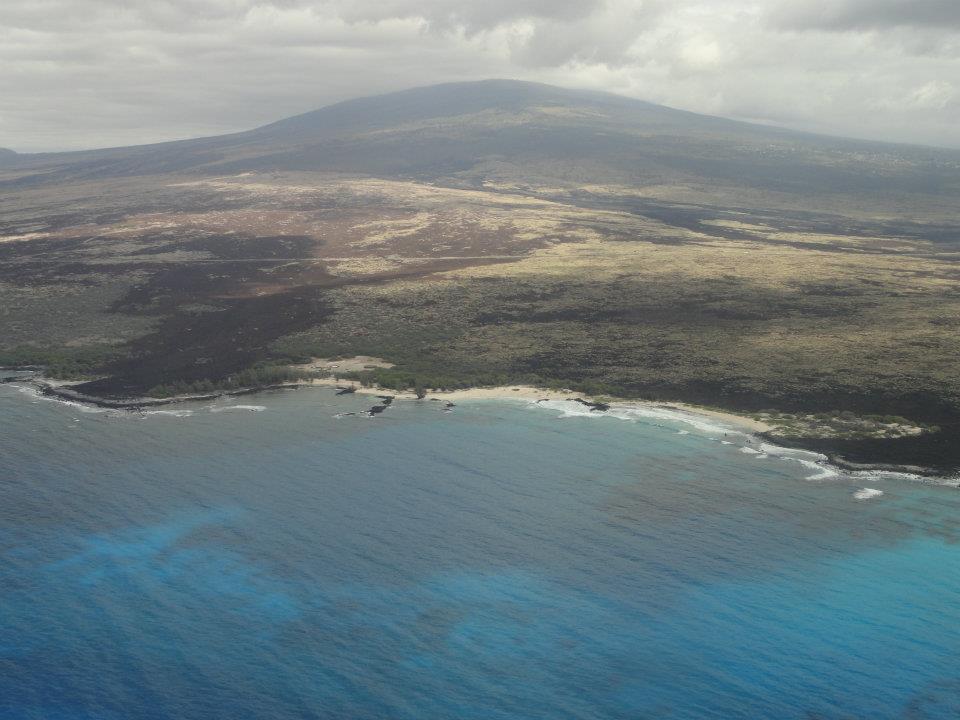
Kohala maybe?The oldest volcano on The Big Island (there are 5 main volcanic mountains that make up the Island) is Kohala, the northern most mountain. It is estimated to be about a million years old, but reached the surface of the water around 500,000 years ago, and the last estimated eruption was around 120,000 years ago. It’s 5,480 feet (1,670 meters) above sea level, and it’s about 5.8% of the land area of the Island. It is considered “extinct”, which means that it will (supposedly) never erupt again.
 
Hualalai maybe?Mauna Kea is considered “dormant”, which means that it hasn’t erupted in the past 200 years (“historic” times), and probably won’t erupt again.
 
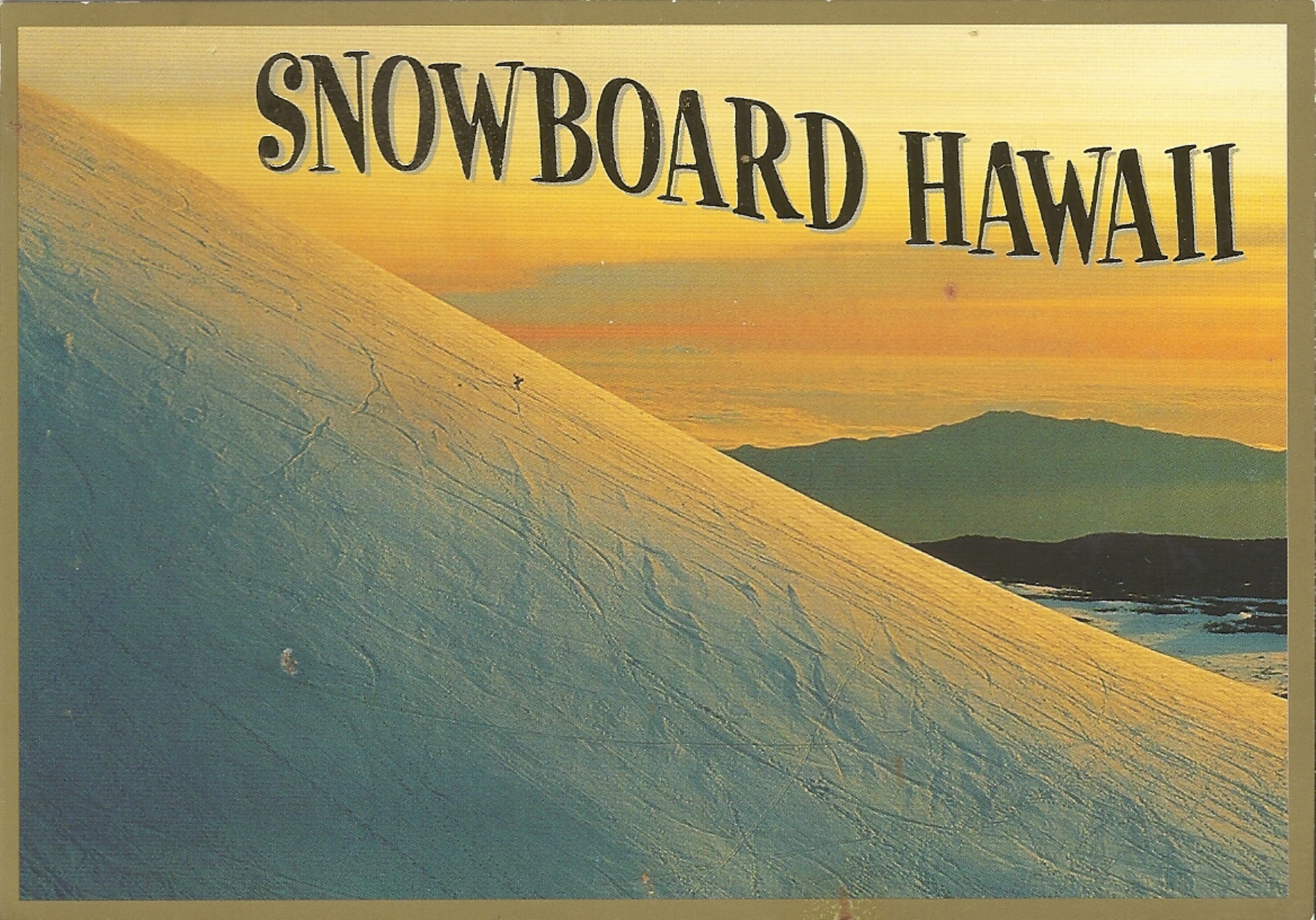
Mauna Kea last erupted around 4,500 years ago. It’s name means “White Mountain” and it often has snow on top. You can even ski and snowboard up there! I think some people even go sledding up there too. I haven’t been up there yet, but it’s definitely on my “to-do” list…well, not to go skiing, I don’t Snowboard postcard

 
think.. it’s REALLY high altitude and often has wind warnings, so timing is tricky.. Plus, I’m not great at skiing and worse at snowboarding… I could maybe sled.. (There’s also caution extended to people who SCUBA, because of the high elevation verses being under the water – something about “the bends”… I guess divers know the restrictions. If not, look it up before you try to SCUBA and summit….Apparently, even if you aren’t diving, altitude-sickness can still be a problem.)


Mauna KeaMauna Kea Mauna Kea is 13,796′ (4205 meter) above sea-level, and the ski hill is at the summit. In fact, Mauna Kea (measured from base to peak) is the tallest mountain on Earth, at 33,476 feet (10,203 meters)!!!! (Mount Everest is 29,035 feet (8,850 meters).. I probably won’t sled. It seems cold. BUT, I’d like to see it.
 
Also up on Mauna Kea is the Onizuka Center for Astronomy (also called Hale Pōhaku, which means “stone house”). They have free stargazing every night! (Yes – this is definitely on my to-do list.) The Center is at 9,300-foot (2,800 m) above sea-level, and it’s suggested/recommended to spend time there to acclimatize, before ascending further.
Hualalai
Hualalai is the Big Island’s oldest ”active” volcano, meaning it has, at some point, in the past 200 years. Hualalai’s last eruption was in 1801.
 
The oldest rocks of Hualalai date back about 128,000, but it’s estimated to have reached the ocean’s surface around 300,000 years ago. It is 8,271 feet (2,521 meters) above sea-level.
 
An eruption is predicted for sometime in the future (in the next 100 years, I read), but is carefully monitored by the Hawaii Volcano Observatory… Hopefully, if anything happens, it’ll be a mild and peaceful eruption… like, a breaking through the surface and a trickling stream down the side…where nobody lives…heh.
 
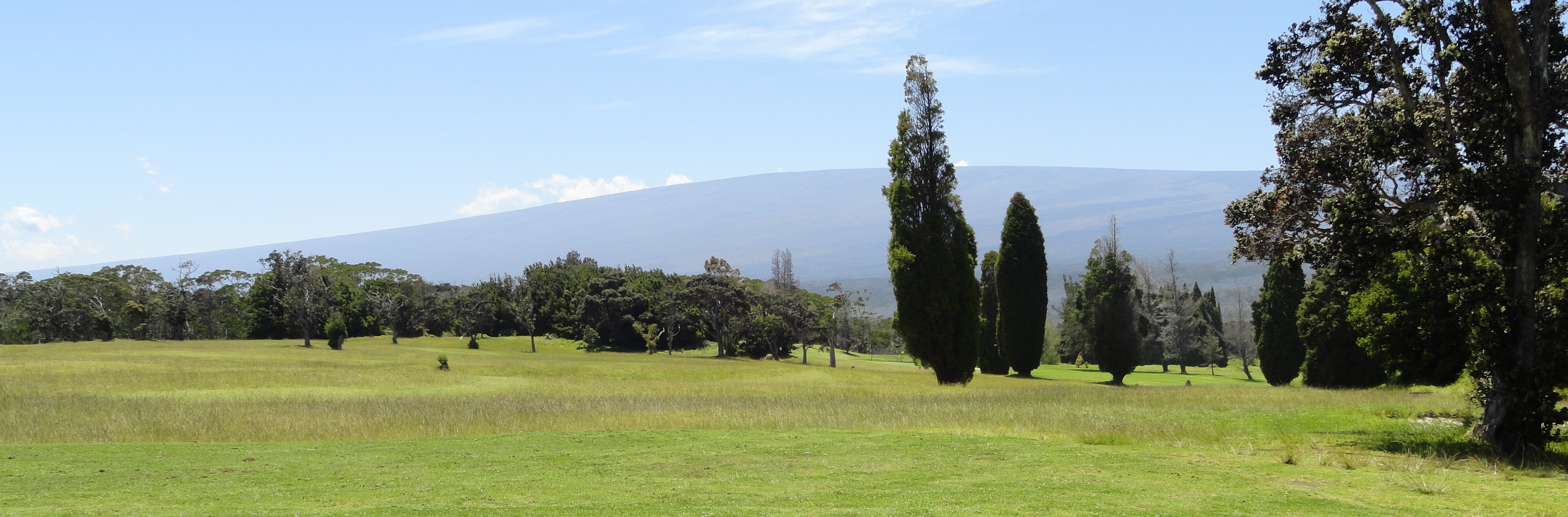
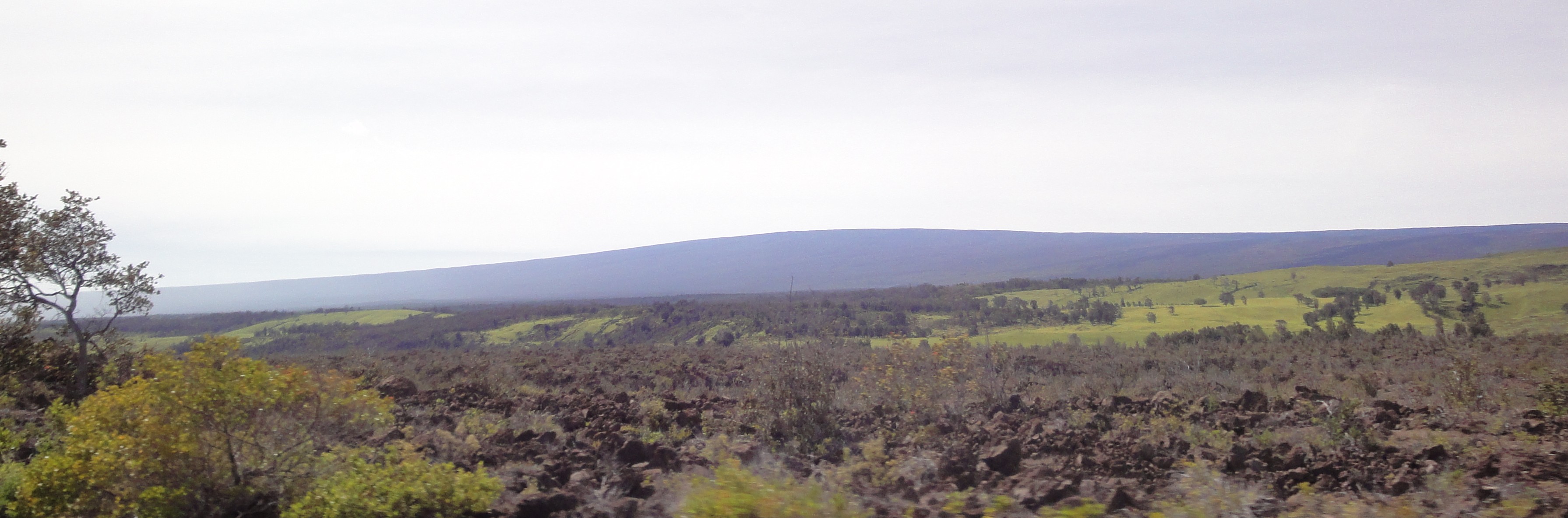
Mauna Loa means “Long Mountain”. This is a great name! It’s HUGE and has the title of being the “Earth’s Largest Volcano“!! It makes up 50% of the total land base for the Big Island. It’s 60 miles long, 3o miles wide, and 13,681 feet above sea-level. It’s below the ocean’s surface by about 5 kms AND THEN! Because it’s soooo huge and heavy, the sea floor has depressed another 8 kms!! So, technically, it’s summit is around 56,000 feet (17kms) above it’s base!! Yikes!
Mauna Loa 1Mauna Loa
Mauna Loa is estimated to be about 1,000,000 years old, but didn’t reach the ocean’s surface until maybe 400,000 years ago, and the oldest rocks are estimated to be in the 100,000 year range. The last eruption was 1984, and is expected to erupt again…someday.
KilaueaAs discussed, volcano’s are categorized as “Extinct”, “Dormant”, and “Active”. Personally, I have a fourth category: “REALLY Active” – those that are erupting right now! There’s probably an official term anyway, but I didn’t happen across it.
 
“Really Active” is Kilauea, possibly earning the title as “most active” in the world. Although it looks like it’s coming from Mauna Loa, it is actually it’s own volcano. “Kilauea” means “spewing”, which is appropriate since it’s been erupting non-stop since 1983.
 
It’s estimated to be between 300,000 and 600,000 years old, and having reached the ocean’s surface between 50,000 and 100,000 years ago. The oldest rocks date to around 23,000 years old. It is currently 4,190 feet (1,277 meters) above sea-level…the Pu’u O’o Vent (the current erupting point) is a “cinder-and-spatter cone” and lava from it flows through Lava Tubes into the ocean, so it isn’t really gaining height at all, BUT about 500 new acres of land have been added since 1983.
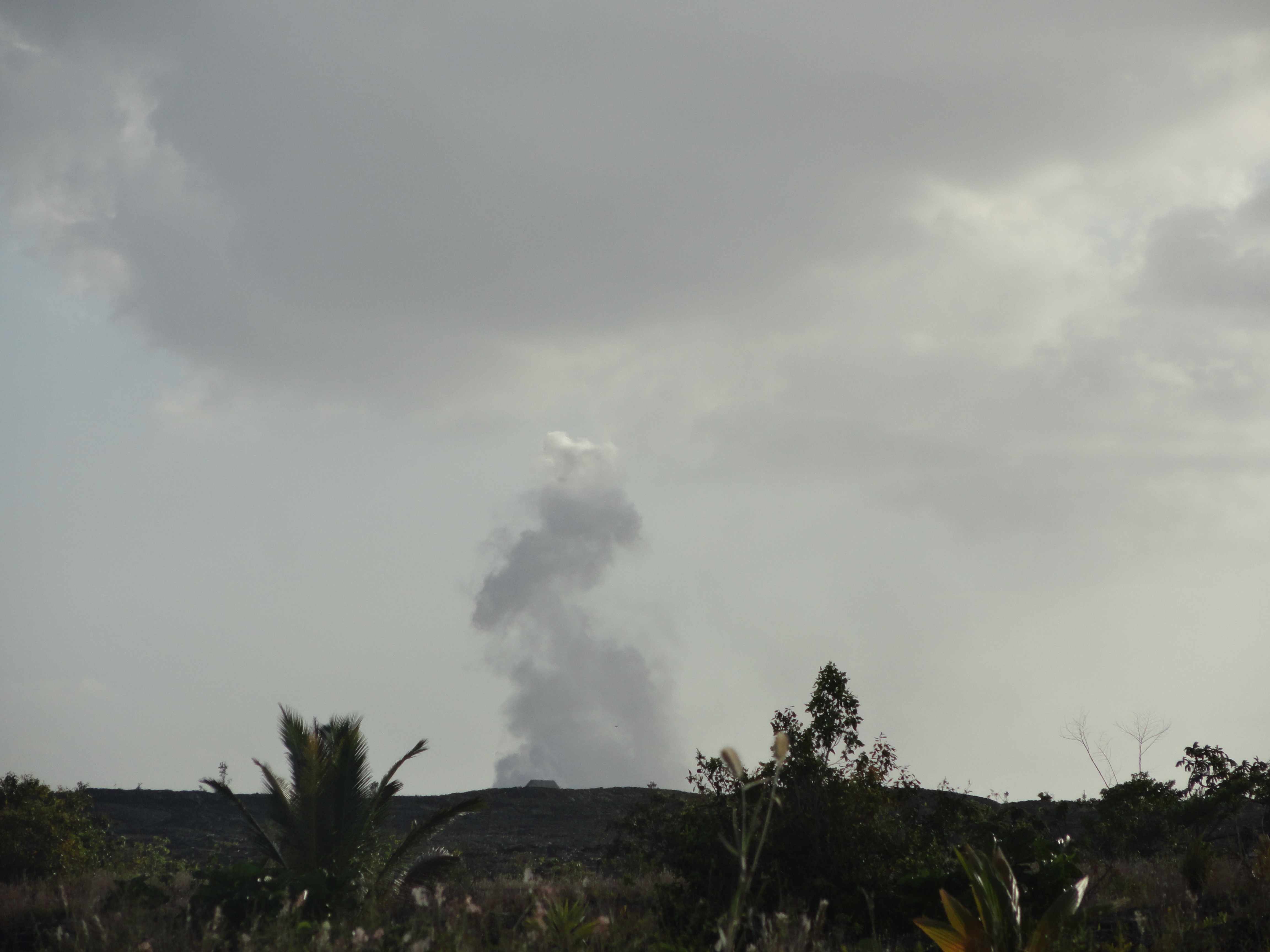
You can see the steam from Pu’u O’o as the lava comes down the mountain and a big plume where it reaches the ocean! Technically, you can hike to get a closer view, but it’s very strenuous and can be dangerous – so do aLOT of research and double check conditions with the Park Rangers at Volcano National Park.
Pu'o O'o
You can also get a pretty good view of the Halema’uma’u Lava Lake right in the Kilauea Crater, from the Jaggar Museum in the Park - it’s kind of at an angle that you can see either steam or the red glow (depending upon the time of day), but not really any liquid lava. They have a web cam, though, too, for an even better view.)
 
Halema'uma'uAn article from October 2012 says that the lava in the Lake had surged about 50 feet (15 meters) and only had about “110 feet (33 m) to go until the lava reaches the top of the vent and floods the crater floor”! (This link has an interesting report from October 2012, plus youtube video.)
 
Wednesday’s blog will be about Kilauea and Volcano National Park. (Oh yes. I’m going to try to get back to a Wednesday/Sunday routine.)
 
Hawaii Mountains
Before I go today, though – I just want to talk about one more active volcano – a “brand new” little up-and-comer – Lo ‘ihi. I’m not sure when it first started erupting, but it reactivated in 1996. It is currently about 931 meters tall on the north side, and 3,786 meters on the south side, since it’s growing on a slope.
 
OK! See you Wednesday!